Fire Damper Testing Company
Annual drop testing for mechanical and spring-operated dampers, with a report your fire risk assessor can file.
Get a quote- StatuteRegulatory Reform (Fire Safety) Order 2005, article 17Source: legislation.gov.uk
- Test intervalAt least every 12 months under BS 9999 (BS 9991 for flats)Source: BESA guidance
- Ask forA test report per damper, with open and closed photosSource: BESA VH001 reporting
- Typical rate£25 to £40 per damper, our estimateSource: How we worked it out
Which test do you need?
Most buildings need the first. Newer offices, hospitals and anything with a smoke control system usually need the second as well.
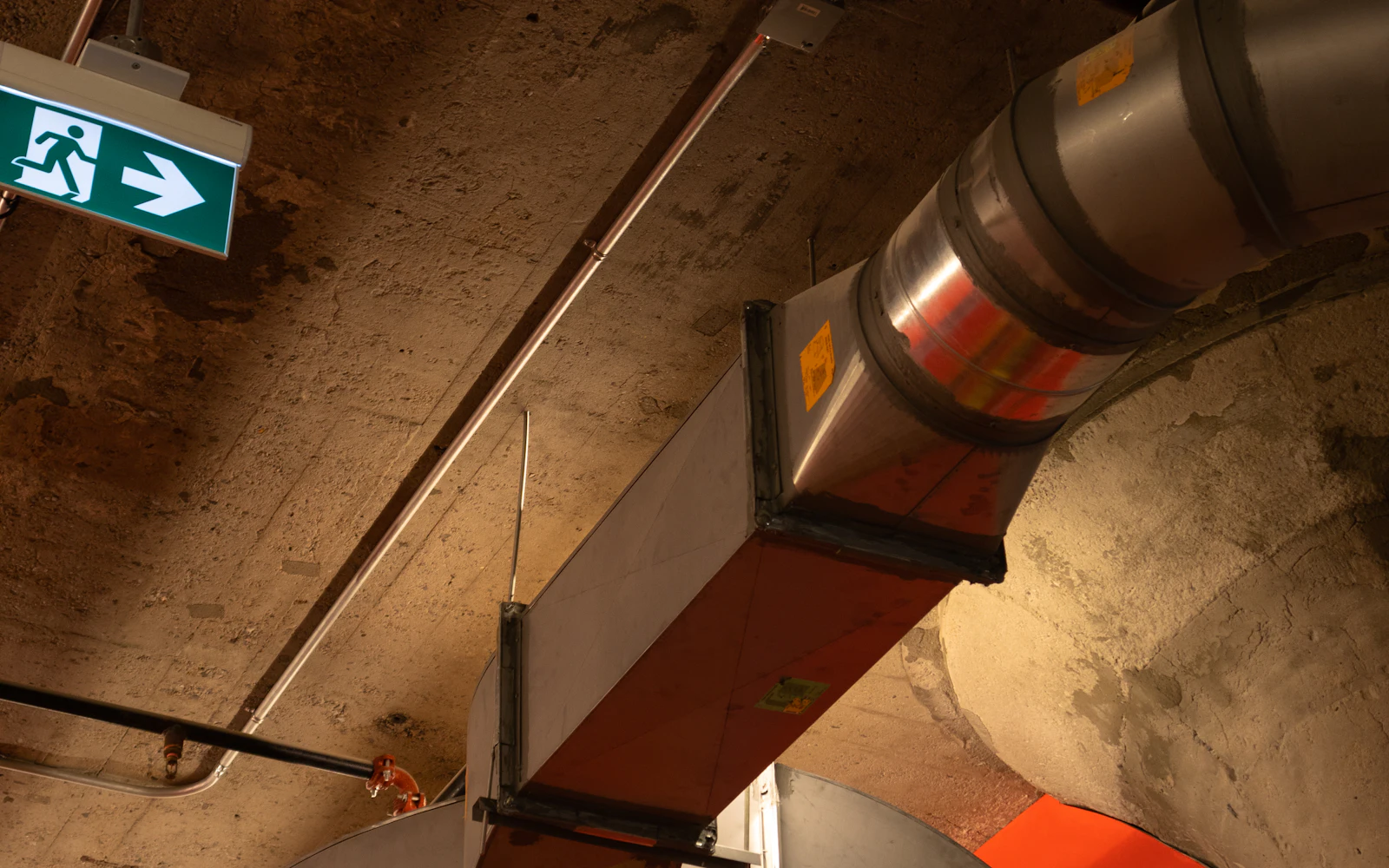 Fire damper inspectionThe yearly visit: every damper found, tagged, closed, reset and photographed, with a report that lists the ones that failed or could not be reached.Read more
 Smoke damper testingMotorised fire and smoke dampers driven from the panel, with the actuator, end switches and alarm interface checked as well.Read more
 Maintenance and repairsSeized blades, snapped links, missing panels and poor fire-stopping put right after a test.Read more
Each type of building has its own testing pattern
The test is the same everywhere. When it happens, how much of the building is covered and where the records go depend on what the building is used for.
Hospitals and clinics
Health buildings follow HTM 03-01 as well as the general rules. IHEEM guidance allows a planned sample for low-risk dampers, rotated so each one is seen within a set cycle (IHEEM technical guidance).
Schools and colleges
Most testing is booked for half terms and the summer, when ceilings can be opened in classrooms and corridors without disturbing lessons.
Offices, shops and hotels
Occupied floors usually mean evening or weekend work, and fixed ceilings are the main cost. A ceiling plan with the damper positions marked saves time on the first visit.
Blocks of flats
In higher-risk buildings the damper records belong in the golden thread of building information kept under the Building Safety Act 2022.
What happens on a test visit
Five things happen at every damper. Ask for all five in the quote so you can compare firms like for like.
Find and tag
Each damper is located from drawings or by tracing the ductwork, then given an asset number.
Look at the fixing
The tester checks the frame is fixed and fire-stopped into the wall or floor it passes through.
Close it
Spring dampers are released by hand. Motorised ones are driven shut from the panel.
Reset and open
The damper is reopened, the link or actuator reset, and the blades checked for free movement.
Photograph and report
Open and closed photos go into a report with a pass, fail or no-access result for each damper.
How a damper test is priced
Firms quote per damper, with a minimum charge for a short visit. The rate drops as the count goes up, so a building with two hundred dampers pays less for each one than a building with ten.
Access moves the price more than anything else. A damper behind a panel takes minutes. One above a fixed plasterboard ceiling, or high in a plant room, can take an hour and a tower scaffold.
The damper cost calculator gives a range for your building, and the price guide shows where the figures come from.
What to ask a damper tester
- Membership of BESA, which runs a Vent Hygiene Register of firms working on ductwork
- A sample report showing open and closed photos for every damper, not just a summary sheet
- Training in damper testing for the people who will be in your ceilings
- Health and safety prequalification such as SafeContractor, CHAS or Constructionline
- Public liability insurance and a method statement for working above occupied rooms
A damper list, even a rough one, comes first
Many buildings do not know how many dampers they have. The first visit often turns into a survey: finding every damper, tagging it and building the register that later tests work from.
If you already have a list, our free fire damper test log shows the columns a good register carries. If you have none, say so in the enquiry and the firm will price a survey first.
Questions about fire damper testing
Is fire damper testing a legal requirement?
The law requires the responsible person to keep fire safety equipment in efficient working order and good repair (article 17 of the Fire Safety Order). It does not name dampers, but dampers are part of the fire separation of a building, and the standard that fire risk assessors work to asks for a test at least once a year. See our regulations guide.
How often should fire dampers be tested?
At least every 12 months, and more often where ducts carry dust or grease, according to BESA guidance on BS 9999. Blocks of flats follow the residential code, BS 9991, and health buildings may use a planned sampling cycle instead.
How much does fire damper testing cost?
Most quotes are priced per damper, with a minimum charge for small jobs. Our price guide has the published ranges and a calculator.
What if we cannot reach some of the dampers?
The report should list them as no access rather than leave them out. Fitting access panels is a separate job, covered on our maintenance and repairs page.
Do you cover Scotland?
Yes. Scotland has its own fire safety law, the Fire (Scotland) Act 2005, but the testing itself and the report are the same.
Tell us where the dampers are
Give us the building postcode and who to speak to. A damper count, a recent report or a ceiling plan all help the firm price it, but none of that is needed to start.
We look for a damper testing firm that works in your area and let you know which one before anything else happens. Your details reach that firm only once you agree, and there is no charge to you.
Your enquiry has arrived.
From here:
- We pick a damper testing firm for the building's area and send its name to your inbox.
- You reply yes or no. Nothing is shared before your reply.
- The firm phones or emails about damper numbers, drawings and access times, then prices the job in writing.